Sir Henry Cotton (1907 - 1987)
Born Cheshire, England, Cotton is remembered as one of Britain's golf luminaries this century. 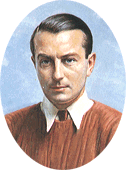
Cotton came from an upper middle class background and went to public school . Already this gives us some insight into the man in terms of the social hierarchy and class divisions which existed within British society at the time. At school, he was banned from playing cricket as a punishment and instead started to playing golf. He was a natural and turned professional upon leaving school at 17.
He was the top British golfer of his time and went on to win the Open 3 times. Indeed he was the only British golfer to win between 1914 and 1989. He also played in four Ryder Cup tournaments. Cotton, like Walter Hagen, brought to the game flamboyance and style, "The best is always good enough for me". Indeed he was well known for his penchant for champagne, caviar and tailored clothing.
Cotton found the establishment's poor treatment of professionals unacceptable and campaigned against it. He always insisted on honorary membership of whichever club he was associated with. He also helped to set up the Golf Foundation. However, it is the way in which he conducted himself which helped more than anything else to earn professionals the respect they deserved.
When World War II broke out, he was given a commission in the Royal Air Force. During that time he helped to organise a series of exhibition matches with other professionals in aid of the Red Cross. This earned him an M.B.E. After the war, Cotton retired and became a journalist, writer and course designer. He designed the Penia course in the Algarve, Portugal and spent his last years living there.
In recognition of his contribution to British golf, the R&A awarded him honorary membership in 1968. A few days before he died he was awarded a knighthood.


